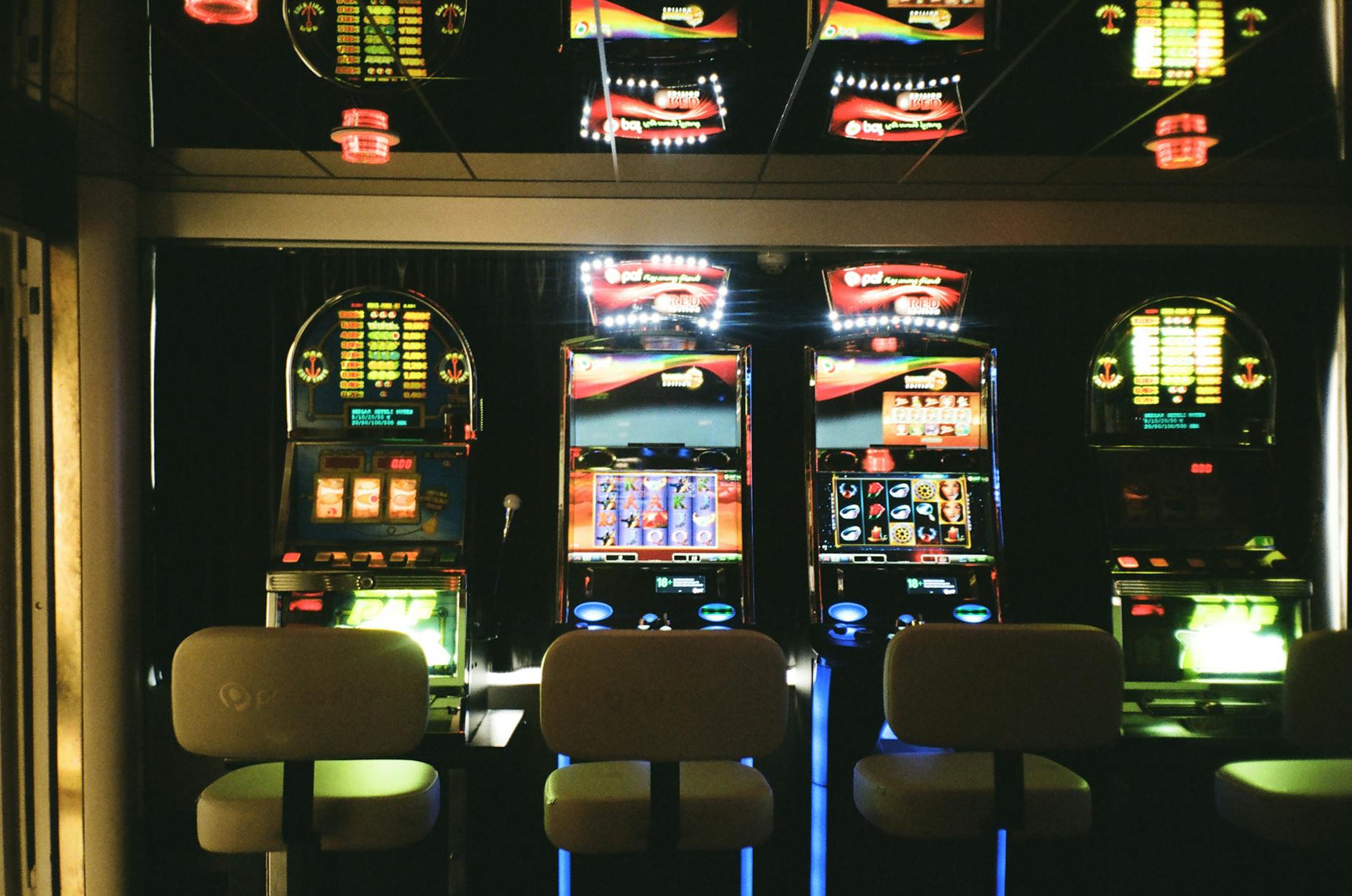
Video 3-Reel Slot game with a scrap-made theme. Play it right here below!
This is a slot game that I am making as a portfolio piece in order to demonstrate some of the skills and experience I picked up over the years in the casino gaming industry.
It’s a video 3-reel slot game, presented as (and internally functional as) a mechanical 3-reel slot. I’ve built it around a fun theme of a scrapyard slot machine with cute retro pixel-graphics.
On the surface, it’s a basic 3-reel slot game with a simple payout structure.
Underneath, it functions exactly like real Class-II gaming systems with a game client talking to a separate ball call server, purchasing a card, making bets, evaluating results, and using a data-driven paytable and presentation mapper to create a reel presentation that is sent to a simulated stepper-motor reel controller spinning authentically-designed reel-art strips!
Check out the sections below for my thoughts while wearing each of the hats!
Check out the source code here on GitHub!
I went into this project with a few requirements not generally found in production scenarios. As a demonstration project, advanced slot play concepts were not considered for this title. I went with the retro-pixel theme intending to make the art pipeline quick and easy so that I can focus on the engineering aspects. Rolling with minimalistic paytables, simple play, and less complex rules allows focus on building up the game platform. The intention here is to build the game platform itself, and a second, more complex slot title can then show game-design skill and working around bigger, harder requirements.
Artist – All of the graphics found within are hand-drawn by myself. Only the [current] title card is AI generated. The mighty pixel-art program Aseprite is used for all assets.
Technical Artist – A custom shader was written for a vertical blur effect that linearly scales with speed, and is used on the reel strips to give them a smooth movement. Allowing the camera to move to look at different parts of the cabinet gives a better feeling of being in front of a slot machine, and allows a better view of specific parts of the game, and helps alleviate a static view.
I selected Godot as the game engine for this project because it serves the requirements for fast delivery, works very well for 2D game development, is lightweight, and easily deploys to web and mobile, which is where this needs to be shown. I also already have a couple of other projects going in this engine, so it was easy to reprioritize over to this project.
I’ve based this design on Class II slots, which in this case, runs a bingo game behind the scenes. This demo will take a phased approach, using a straight RNG during construction of the game platform, and moving to a bingo server/card dauber client interface communicating via broadcast.
The architecture of the game client is split into three layers: the Game layer, the Platform layer, and the RNG layer. These layers communicate through Godot’s signal system (basically an event bus), and serve to separate the game presentation, from the mechanism powering it. The game client can also be started in ball-call server mode where it’ll act as the ball-caller handing out cards and results to the client-configured instance.
The Game can be easily rethemed with this design, paytables can be swapped out with a resource swap, and the RNG can be swapped out with other designs, such as lottery-draw systems found in some CII jurisdictions. The Platform is built using a state-machine design pattern, allowing additional functionality to be added simply by adding new states. Complex button, bonus, and other behaviors are easy to manage and encapsulated into their own states.
The reelset module will also be a encapsulated, and will make it easy to swap out to other configurations, like 5 reels, or bonus presentations.
No security or encryption has been built in because it’s a demonstration piece and needs to be inspectable.
My studio uses Codecks.io for our Scrum board and ticket tracking system. If you’ve never heard of it, check it out! I’ll put the link up to my public board up soon, so you can check out my specific use-case and the processes that I have refined from 15 years of using Agile processes. Codecks gamifies a typical Scrum process into a deck-building game, and give tons of project management tools around it.
I went ahead and created the project space for the Junkyard Jewels slot game project, and created three decks that I will start creating cards into. I find that splitting work up by technical areas like software layers or modules makes creating logical chunks of work that can be divided up into sprints a lot easier. If you divide your project tracking work with too much of the vertical in each piece, you can run into some dependency problems during development. This can result in work items staying open for a long time waiting on those dependencies.
In this case, the decks are divided into the architectural layers of the game software: the Game layer, the Platform layer, and the RNG layer. Since the pieces are separate from each other and talk through defined interfaces, whatever development happens inside each deck can go on without affecting the others. This also helps with resource allocation (or in my own case, will help once I have more than just me developing for the studio). The Game deck, for example, will be assigned to the Creative team folks, the Platform deck will get assigned the software devs, and the RNG layer (in the case of a casino gaming studio) would get the mathematician and design people.
I’m going to run a deck-building session every two or three days at this point to start fleshing out the decks, assigning size estimates as I go. I’ll start to get an idea of projections after about four weeks. I should have a large percentage of the work documented and estimated and a couple of sprints in to start establishing a velocity.
This game is coming together quick, though, we’ll see if there ends up being enough data to do something with.
This most recent sprint has moved things along significantly.
– Finally got the reel targets hitting accurately (the mechanical simulation running behind the video reels setting reel stepper-motor targets)
– Created the ballcall server and wired the game to talk to it instead of using hardcoded results
So now you can see two instances of the game, one of them set to act as a ballcall server serving balls and cards to the client and displaying that activity.
This hits a major milestone in this project, and everything from here is tidying up and getting it all up to show.
This has been a fun one!
Next milestone is making a second title that I can build on top of the platform showing how easy it is to do re-skins and to add on gameplay features with this architecture. It’d be really cool to see them both playable next to each other and talking to the same ballcall server with the server showing that traffic.